


How do you know something's funny? A good sign is when it makes you laugh. However, I remember watching the Fast Show when it was first on and finding it very funny but not laughing - at least not until later. And funny is probably the easiest to know.
How do you know that you like a food? Obviously, if you enjoy eating it is a pretty good sign. But then why bother acquiring a taste if you don't immediately like it? How do you know it's a taste worth acquiring?
Reflecting on most things we think we know, it seems to me that paradoxically it all comes down not to the rational "knowing", but to the feeling of "knowing".
So how do you kinow whether somebody is good to do business with? How do you know whether you've spent your working day well or badly? How do you know whether your plans are giood or not?
Sooner or later, what we call "knowing" comes down to a feeling. Our evaluation of knowing and in fact of everything else ultimately comes down to how we feel about it.
Wednesday, 24 February 2010

Wednesday, 17 February 2010
My favourite model
Yesterday evening I had a long rich conversation with my friend Jeremy, covering (among many other things) models of interaction. In plain language, I mean the roles that are implicit or explicit in interactions between people
We were struggling to find a description of the model that I naturally use. The key elements are:
- Equal partners: no single party owns the high ground or runs the agenda
- Open agenda: exploratory, not instrumental towards achieving a specific improvement or outcome
- Creative: building on each others' inputs
- Unselfish: feeding the conversation, not the ego - no point-scoring
- Authentic: speaking from the heart, honestly
It's not small talk but it's not heavy talk either. It's definitely not coaching or therapy or motivational, although the effect can be any/all of those.

We were struggling to find a description of the model that I naturally use. The key elements are:
- Equal partners: no single party owns the high ground or runs the agenda
- Open agenda: exploratory, not instrumental towards achieving a specific improvement or outcome
- Creative: building on each others' inputs
- Unselfish: feeding the conversation, not the ego - no point-scoring
- Authentic: speaking from the heart, honestly
It's not small talk but it's not heavy talk either. It's definitely not coaching or therapy or motivational, although the effect can be any/all of those.
Professional Thinking and Writing
Powered by ScribeFire.
Sunday, 31 January 2010
Gun worship, the global religion of our time
When I was a kid it was all cowboys and Indians, and I fashioned Colt 45s out of bits of wood and Lego. Then it was the Man from Uncle, James Bond, Dirty Harry, then later the ironic gun play in Tarantino films. Then of course there's "24" and numberless gun-toting films and series on TV.
I can't imagine how many people I've seen get shot in the name of entertainment. It's normal, par for the course, all in a day's viewing. From a certain perspective it's not so different from the bread and circuses of Ancient Rome, where the plebs went along to watch gladiators fight and die for their pleasure. The difference now is that we don't smell the fear and the blood, plus we get close-ups and slow-mo shots of bullets meeting flesh and exiting amid a spray of blood.
My youngest came back from an overnight today, having played an 18-plus rated video game. "I killed eight in my go, but Joe's record is 27 - that's amazing". Part of me felt disgusted and part of me thought, don't be stupid, boys will be boys.
It's bad enough living in a global popular culture where gun worship is widespread, casual death by shooting is normal. I'm just glad I live in a country and a continent where most people don't carry guns and confine their gun worship to screens.
I can't imagine how many people I've seen get shot in the name of entertainment. It's normal, par for the course, all in a day's viewing. From a certain perspective it's not so different from the bread and circuses of Ancient Rome, where the plebs went along to watch gladiators fight and die for their pleasure. The difference now is that we don't smell the fear and the blood, plus we get close-ups and slow-mo shots of bullets meeting flesh and exiting amid a spray of blood.
My youngest came back from an overnight today, having played an 18-plus rated video game. "I killed eight in my go, but Joe's record is 27 - that's amazing". Part of me felt disgusted and part of me thought, don't be stupid, boys will be boys.
It's bad enough living in a global popular culture where gun worship is widespread, casual death by shooting is normal. I'm just glad I live in a country and a continent where most people don't carry guns and confine their gun worship to screens.
Professional Thinking and Writing
Saturday, 30 January 2010
Thinking about the brain
Have you been listening to A History of the World in 100 Objects? It's compelling listening for anyone interested in our species and our world.
It's also so refreshing to have it in purely audio form rather than on TV. As soon as video cameras get involved, they hijack the whole thing and all too often we end up with video cliches. When it's purely audio, it relies on the descriptive powers of the speakers.
Anyway, one fascinating insight is that although human beings have so much DNA in common with primates such as chimps, our brains are asymmetrical whereas other primate brains are symmetrical.
Another is that, according to the programme, fMRI shows the brain areas involved with speech overlap with the areas activated for knapping stones (chipping stones to make tools). The hypothesis from this is that stone knapping and speech co-evolved.

It's also so refreshing to have it in purely audio form rather than on TV. As soon as video cameras get involved, they hijack the whole thing and all too often we end up with video cliches. When it's purely audio, it relies on the descriptive powers of the speakers.
Anyway, one fascinating insight is that although human beings have so much DNA in common with primates such as chimps, our brains are asymmetrical whereas other primate brains are symmetrical.
Another is that, according to the programme, fMRI shows the brain areas involved with speech overlap with the areas activated for knapping stones (chipping stones to make tools). The hypothesis from this is that stone knapping and speech co-evolved.
Professional Thinking and Writing
Friday, 29 January 2010
Mixing fun and serious in business
A couple of weeks ago I had a message from somebody (not a business contact) commenting on the style of threads on Ecademy, the social business networking site. As you will see, the person doesn't regard Ecademy as a place where serious business is done or discussed, nor indeed where serious business people hang out.
"Now the threads at Ecademy have so many batty cartoons and loud-font signatures (and let's add the Skype icons along with the Twitter icons which trail the colored membership stars, etc.) and the average Ecademy thread looks like a MySpace page where twelve-year-old are attaching cool avatars or catchy quotes by Cicero or by Robbie Williams as they complain, using frowny faced icons, that their parents don't understand them."
I can see the point that this person is making, but on the other hand a lot of serious new businesses (e.g. Google) use whacky graphics and fun stuff. I know that that Smugmug, a 10-year-old photo sharing site that's been self-funded and profitable all along, does some pretty whacky stuff back at base.
I've no doubt that there are plenty of buttoned-down businesses people who would fire everybody on Ecademy in a heart-beat for not being serious. There are some very hard-nosed, glum people around. A very senior contact of mine recently told me about attending a board meeting of his company in the USA where the CEO was ranting about health care and commies.
However, I think that there are plenty of successful young companies proving that it's perfectly possible and even desirable to be effective in business while keeping a light touch and a sense of play.
"Now the threads at Ecademy have so many batty cartoons and loud-font signatures (and let's add the Skype icons along with the Twitter icons which trail the colored membership stars, etc.) and the average Ecademy thread looks like a MySpace page where twelve-year-old are attaching cool avatars or catchy quotes by Cicero or by Robbie Williams as they complain, using frowny faced icons, that their parents don't understand them."
I can see the point that this person is making, but on the other hand a lot of serious new businesses (e.g. Google) use whacky graphics and fun stuff. I know that that Smugmug, a 10-year-old photo sharing site that's been self-funded and profitable all along, does some pretty whacky stuff back at base.
I've no doubt that there are plenty of buttoned-down businesses people who would fire everybody on Ecademy in a heart-beat for not being serious. There are some very hard-nosed, glum people around. A very senior contact of mine recently told me about attending a board meeting of his company in the USA where the CEO was ranting about health care and commies.
However, I think that there are plenty of successful young companies proving that it's perfectly possible and even desirable to be effective in business while keeping a light touch and a sense of play.
Thursday, 28 January 2010
Subtle seems to be the hardest word
We are constantly buffeted by hyped up blasts of "awesome", "brilliant", "revolutionary", "transformational", "sensational", "utterly", "massive".
Trillion is the new billion, billion is the new million, million is yawn.
With everybody is shouting louder, harder, more vividly, more outrageously, the signal-to-noise ratio degrades. There's so much noise that we all turn up our filters, which makes it harder to pick up the signals.
All of this works against the development of subtle skills, which are essentially the ability to create and to discern fine critical distinctions. It also works against the appreciation of the fine grain of experience, the details of life. Great professionals and people who achieve great things invariably have a great capacity for subtlety.
Trillion is the new billion, billion is the new million, million is yawn.
With everybody is shouting louder, harder, more vividly, more outrageously, the signal-to-noise ratio degrades. There's so much noise that we all turn up our filters, which makes it harder to pick up the signals.
All of this works against the development of subtle skills, which are essentially the ability to create and to discern fine critical distinctions. It also works against the appreciation of the fine grain of experience, the details of life. Great professionals and people who achieve great things invariably have a great capacity for subtlety.
Wednesday, 27 January 2010
Since I took a tumble on the ski slopes in late December, I've been getting a lot of nagging pain from the rotator cuff of my right shoulder.
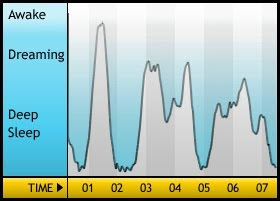
It's okay during the day, mostly, and I think it's getting better, gradually. But it keeps waking me up at night, which means I don't often get a decent night's sleep. So imagine my delight at having woken only once, briefly, last night, and sleeping through till 7:30. My SleepCycle app in the iPhone even tracked the night for me:
Sleeping well is such a blessing. Sometimes, after a particularly good sleep, the word that springs to mind is "delicious". My heart goes out to those unfortunates who don't manage to get good sleep, for whatever reason.
It's okay during the day, mostly, and I think it's getting better, gradually. But it keeps waking me up at night, which means I don't often get a decent night's sleep. So imagine my delight at having woken only once, briefly, last night, and sleeping through till 7:30. My SleepCycle app in the iPhone even tracked the night for me:

Sleeping well is such a blessing. Sometimes, after a particularly good sleep, the word that springs to mind is "delicious". My heart goes out to those unfortunates who don't manage to get good sleep, for whatever reason.
Friday, 4 December 2009
Logic vs. emotion is a false dichotomy
All transactions and all actions are emotional. They involve and trigger feelings. In normal life, a non-emotional state does not exist. The mind-body organism just does not function without emotions. Even the most apparently rational, logical person is emotionally active, although they will probably have developed ways to control the intensity of their emotions.
Only machines are completely logical, operating entirely on the basis of data, unaffected by any emotional associations with the data.
Whatever the buying decision and the focus of attention (technical specs, colour etc.) the process proceeds or not on the basis of emotional checks or impulses. It proceeds on the feelings that the prospective buyer has about the product in the here and now, the feelings that they have about the buying process and the feelings they expect to have if the buy the product and use it.
Logic vs. emotion is a false dichotomy.
There's information that is relevant to the buyer (the colour, the engine size, the procession speed, the name of the designer, the tone of the salesman's voice, how clean the toilets are etc.) and there is the buyer's emotional response to it.
Only machines are completely logical, operating entirely on the basis of data, unaffected by any emotional associations with the data.
Whatever the buying decision and the focus of attention (technical specs, colour etc.) the process proceeds or not on the basis of emotional checks or impulses. It proceeds on the feelings that the prospective buyer has about the product in the here and now, the feelings that they have about the buying process and the feelings they expect to have if the buy the product and use it.
Logic vs. emotion is a false dichotomy.
There's information that is relevant to the buyer (the colour, the engine size, the procession speed, the name of the designer, the tone of the salesman's voice, how clean the toilets are etc.) and there is the buyer's emotional response to it.
Wednesday, 30 September 2009
Real brands winning me over in social media
I've been delighted by the way brands have interacted with me on Twitter.
Around April, I tweeted about RunKeeper, an iPhone app I had just bought. Within hours the developer, Jason Jacobs, was responding to me. Within a couple of days I was interviewing him for an article I wrote for a client.
Around the same time I tweeted something about Boingo. They too were on to me like a shot, helpful as could be.
Two weeks ago, the BT Business Hub in my hub office went down. I tweeted about it, and within an hour @BTCare was onto it, asking me questions and passing me on to @BTBusiness. They quickly got their service person Lisa Nield to call me, talk me through the problem and decide on dispatching a new modem router. I asked if I could have a chat with one of the masterminds behind BT's social media work and hey presto, Martin Faux rang me later that day.
Then yesterday, I happened to mention my favourite photo sharing site Smugmug in a Tweet. Within less than an hour one of the co-founders DonMacAskill had commented on my tweet and was following me.
One take-out for me is that businesses who notice customers and prospects get their attention - they deserve their attention.
I've also posted this here >>>>
Around April, I tweeted about RunKeeper, an iPhone app I had just bought. Within hours the developer, Jason Jacobs, was responding to me. Within a couple of days I was interviewing him for an article I wrote for a client.
Around the same time I tweeted something about Boingo. They too were on to me like a shot, helpful as could be.
Two weeks ago, the BT Business Hub in my hub office went down. I tweeted about it, and within an hour @BTCare was onto it, asking me questions and passing me on to @BTBusiness. They quickly got their service person Lisa Nield to call me, talk me through the problem and decide on dispatching a new modem router. I asked if I could have a chat with one of the masterminds behind BT's social media work and hey presto, Martin Faux rang me later that day.
Then yesterday, I happened to mention my favourite photo sharing site Smugmug in a Tweet. Within less than an hour one of the co-founders DonMacAskill had commented on my tweet and was following me.
One take-out for me is that businesses who notice customers and prospects get their attention - they deserve their attention.
I've also posted this here >>>>
Friday, 18 September 2009
Tidying up after leaving an online forum
Good old Mitch Sullivan, the recruitment expert, has the right idea about interacting online; it's not the real world, so don't take it too seriously. Wise words and I'm trying, honestly.
However, this year, the behaviour of one particular person in one particular forum (LT) got right under my skin. It didn't seem to bother anyone else in the forum, so I guess it was just my own weak spot. I tried ignoring it, I tried just staying away, I tried mocking the behaviour as Mitch advised and none of it worked. So I left the forum and asked the owner to delete my account. And I once again became more active on Ecademy, where I started out my online networking activities in December 2004.
For the good order, I would like to express my appreciation for various people on LT:
- Coaksey for his humour, balance and for sharing difficult moments of his year
- Rupert for his intelligence, erudition and for playing the ball, not the man
- JH for patiently hosting the whole thing
- Mollie for her unique wit and incisive perspectives
- Rachie for putting me straight on websites
- RAD for being an all-round good man with a great sense of fairness
- Mitch for being a provocative, funny and insightful nutter
- MJ for his dry, wry, pithy humour
- Bood for being the deep-thinking, reflective peace-maker
- JW for reconciling me with Ecademy again
- Nikki for taking no prisoners
- DH for being a unique monomaniac
- Essex Girl for her spirit, curiosity and kindness.
Apologies to anyone I've missed out - I guess we weren't so much on each other's radar.
However, this year, the behaviour of one particular person in one particular forum (LT) got right under my skin. It didn't seem to bother anyone else in the forum, so I guess it was just my own weak spot. I tried ignoring it, I tried just staying away, I tried mocking the behaviour as Mitch advised and none of it worked. So I left the forum and asked the owner to delete my account. And I once again became more active on Ecademy, where I started out my online networking activities in December 2004.
For the good order, I would like to express my appreciation for various people on LT:
- Coaksey for his humour, balance and for sharing difficult moments of his year
- Rupert for his intelligence, erudition and for playing the ball, not the man
- JH for patiently hosting the whole thing
- Mollie for her unique wit and incisive perspectives
- Rachie for putting me straight on websites
- RAD for being an all-round good man with a great sense of fairness
- Mitch for being a provocative, funny and insightful nutter
- MJ for his dry, wry, pithy humour
- Bood for being the deep-thinking, reflective peace-maker
- JW for reconciling me with Ecademy again
- Nikki for taking no prisoners
- DH for being a unique monomaniac
- Essex Girl for her spirit, curiosity and kindness.
Apologies to anyone I've missed out - I guess we weren't so much on each other's radar.
Subscribe to:
Posts (Atom)