


Over the past 30 years, and especially the past 20, we've seen the lionisation of business and entrepreneurs. In no particular order, Steve Jobs, Richard Branson, Bill Gates, Jack Welch, Mark Zuckerberg, Alan Sugar,Sergei Brin and Larry Page are all celebrities recognised and admired by millions. The Apprentice and Dragon's Den are prime time viewing.
Many people aspire to have some of that oomph and to be entrepreneurial in one way or another. It's exciting, it's self-expressive, it's changing fast, it's very now. Sexy. And of course as we have learned to the point of orthodoxy, virtually everything in our society depends on business and entrepreneurs coming up with new products, employing people and keeping the wheels of the economy turning.
Now, with austerity looming and the need to pay down the huge debts the UK (and other countries) have run up, business people and entrepreneurs are looking to their wallets and passports and wondering whether they should move somewhere that's more business-friendly and takes less in tax.
I don't like paying tax any more than anyone else and I don't like waste of tax money of the sort highlighted routinely by the Daily Wail and others. I don't like "big government" that demands and controls increasing proportions of the national pie.
I don't like selfishness either. Among entrepreneurs and business people I see a great lack of appreciation for ordinary people who provide vital public services for pretty poor money - teachers, nurses, servicemen and women, emergency service workers, police, prison officers etc. Every country has them - has to have them - and every country has to pay them. How they are funded is a moot point - the business models that they work by. They have to be paid a living wage, even if they're imported from low-wage countries (ooops, immigration issues).
There seems to be a general assumption that a lot of public service workers are in their job because they haven't got the wit or energy or courage to do something more entrepreneurial: that they're losers and slackers with no get-up-and-go. Somehow we have lost the understanding that public service can be an honourable and admirable calling, a source of great satisfaction and pride and even moral principle.
It's a huge paradox that the people who earn least do jobs we rely on most, and the people who earn most do the most superfluous jobs.
Friday, 21 May 2010

Thursday, 20 May 2010
"Like talking with a brochure"
Having a conversation about Richer Conversation with a local professional today who came up with a beaut.
"With a lot of middle managers it's like talking with a brochure. After a conversation with them I feel exhausted."
Whatever the context, business or private, feeling exhausted or glum afterwards is a sure sign that the conversation wasn't rich.
"With a lot of middle managers it's like talking with a brochure. After a conversation with them I feel exhausted."
Whatever the context, business or private, feeling exhausted or glum afterwards is a sure sign that the conversation wasn't rich.
Tuesday, 18 May 2010
And then she explained what Art is
"What is art?" I really don't but I have long felt that I was missing out on something by not even having the vaguest idea. Sure, I've seen all the paintings in Rome and Florence and Paris and various museums around the place. I've got a few art books, notably Vermeer, a favourite. I've got a few books of art photography - Mapplethorpe, Ernst Haas and the like. But I didn't really know.
So I called my friend Sarah J, who's a mature art student in her first year (second if you count the Foundation Year). We met up yesterday for a coffee and she had brought along a load of reading materials, including a copy of her autumn term essay comparing Art Photography with Non-Art Photography. So that's where the conversation started.
It was a treat. It ranged far and wide in (as I discovered from Sarah) a way that the Surrealists would have liked. Neither of us was embarrassed to use high-fallutin language or struggle with abstractions, and it all felt rooted in experience and passion. I learned much more than I expected, both from Sarah, from myself and from the conversation. And even if I can't give a pat answer to the question "what it art?" I have much more of a feeling for what it means.
Monday, 17 May 2010
Male fashion and the vexed question of shirt collars
Men of a certain age don't face many fashion questions beyond "shall I throw those trousers out or lose a few pounds and use them again?"
One that has vexed me of late is: "Why are virtually all shirt collars now of the sort that I don't get on with?" Namely the spread shape in the image below.
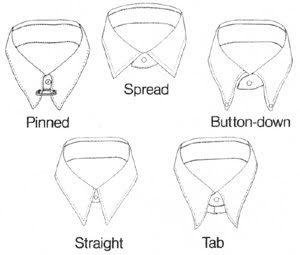
I have tried a few variations on the spread collar and I like none of them. Button-down, straight or tab are my preferences. I tried at Lewins a couple of months ago and they were all spreads. I tried at the Bath M&S on Saturday and out of a huge selection, I reckon that 90% of the shaped collars were variations on the spread.
Maybe I'm just completely out of tune with the sartorial times. Mind you I did manage to get a shirt that should meet the approval of LaRae Wilkins, who alerted me to the fraught issue of colours.
One that has vexed me of late is: "Why are virtually all shirt collars now of the sort that I don't get on with?" Namely the spread shape in the image below.
I have tried a few variations on the spread collar and I like none of them. Button-down, straight or tab are my preferences. I tried at Lewins a couple of months ago and they were all spreads. I tried at the Bath M&S on Saturday and out of a huge selection, I reckon that 90% of the shaped collars were variations on the spread.
Maybe I'm just completely out of tune with the sartorial times. Mind you I did manage to get a shirt that should meet the approval of LaRae Wilkins, who alerted me to the fraught issue of colours.
Friday, 14 May 2010
These days every day feels like Christmas
I'm finding that every day can feel like Christmas as long as I have a good conversation with somebody and I do it in a spirit of openness, curiosity and no ego tripping.
In practice Christmas isn't everybody's favourite event (certainly not mine) and it's not even relevant to non-Christians. But what I'm talking about is the idealised version - giving and receiving gifts.
Take today. Going into the office I passed the owner of the cafe downstairs. Smart arse that I am, I said "Good day" to her in Polish (she's Polish). Idiot that I am, I actually said goodbye. She laughed and explained. I laughed and slapped my forehead. So I got her to write the words for good day (dzień dobry), Then her Guatemalan husband joined in and we had five minutes of lively chatter when we both learned something - about the words but also about each other.
The more I explore conversation, the richer I find it.
Tuesday, 4 May 2010
On being like Leica - the Richer Conversation analogy
What is Richer Conversation? I know what I mean and people who have spent time with me know what I mean. But what about everyone else. I have been looking for an analogy to illustrate / communicate the essentials of this premium service. I was fiddling around with Rolex and similar luxury brands, then I realised a better analogy for Richer Conversation is Leica cameras. Here's why. Your feedback will be valued and I guarantee to respond.
-----
For those of you who aren't familiar with the brand, Leica is a German brand with over 75 years of heritage, being the favoured camera of photography legends such as Henri Cartier-Bresson and Robert Capa. The classic Leica concept, embodied in the M-series, is unlike anything else in photography.
Mechanically they are extremely high quality and last forever, both the cameras and the lenses. This makes them very expensive. The M7 film camera body alone costs around £2,758.00 and the digital M9 costs £4,850.00. A simple 50 mm lens will cost at least £1,000 new - they don't do zooms.
Technically, they don't use the mirror/reflex system you get on an SLR. Rather than looking through the lens, you look through a viewfinder. There's no clunky mechanism flipping the mirror up and down with a judder and a noise. It's quiet, small and discreet.
They don't come loaded with gadgets enabling you to "point and shoot" - they demand some knowledge of photography and they take learning to use. They're not for happy snappers and they're not for photographers who like chunky great bits of kit.
People who use Leicas have a whole different mindset and feeling about taking photos. Every aspect of the Leica (history, design, brand, technology etc.) pushes the user to see things differently, with a heightened sense of awareness.
The essence of the analogy for me is this. Everyone can take photos but when someone uses Leica, they engage more with their photography and get more out of it. Similarly everyone has conversations, but people who embrace Richer Conversation engage more with it and get more out of it.
- How would you boil the Leica analogy down to the essentials, so that it communicates quickly?
- Any other brands that might have a similar dynamic of fundamentally changing the user's relationship with the function the brand serves? I rejected Rolex because it doesn't change the owner's relationship with time. And Apple is too mass market.
------
* No offence to happy snappers nor to "serious" photographers. For the record, I use a Canon SLR and lenses and I don't (yet) have any Leica kit.
Tuesday, 27 April 2010
Watch out, he's an intellectual !!
Yesterday evening my friend Andrew commented to another friend, half tongue in cheek: "Stuart is a real intellectual". Now I may be wrong, but "intellectual" is rarely used as a neutral handle for somebody in the way we use "tall" or "talkative". Quite often during the past century people labelled as intellectual were villified and even killed.
So over the years I've tended to assume it's a put-down, a short-hand way of saying that someone has their head in the clouds or even up their arse. Then last week, in conversation with somebody else whom I regard as a real business "player" several leagues above mine, he said he was surprised that I wanted to meet up with him because (his words) "you're educated and I'm not".
So maybe "intellectual" is sometimes used from a defensive impulse rather than with offensive intent. Maybe I should just take as a neutral description. Or maybe I should just accept that no description of anybody is ever really neutral.
Wednesday, 14 April 2010
A week of conversation and still going strong
Over the years I've been on a few extended busienss trips abroad with colleagues and clients, and always enjoyed them. Always. Last week I was off to Sicily with a BIG Dutch client, Pim Berkhout, founder and main owner of de Arbodienst..
I say BIG advisedly because Pim is tall and hefty - heftier than he would like to be. He also has a big voice and a very big personality. He can be daunting and domineering.
He likes to do his brainstorming and business in interesting places. So we met up in Rome airport on Saturday 3rd April, flew on to Catania and spent much of the next eight days in conversation over breakfast, lunch and dinner, as well as between meals. Mostly the conversations were in English, occasionally in Dutch and sometimes in Italian. And amazingly, by the end of the week we were still going strong, conversationally.
Our agendas were very open - we were both looking for ideas and inspiration to move our respective businesses and possibly to seek some opportunities for collaboration. Pim is highly entrepreneurial and I have other skills and interests, so we learned a lot from each other.
At the beginning of the week I wondered how we would fare spending so much time with each other. Would we run out of things to say? Would be get bored with each other. Once again, I learned that it's possible, with the right intent and skills, to spend many hours and many days with someone and still have fresh, rich conversations.
Tuesday, 30 March 2010
Men and conversations - is it true?
Conventional thinking says that women are much better at general, open-ended conversation than men are. I can certainly think of a number of men - often the male half of a couple - who are really hard work in conversation. However, I can also think of quite a few men who are a pleasure to talk with, and quite a few women who are hard work.
Conventional thinking says that women try harder in conversation because - either by nature or by conditioning - they are more focused on smoothing things along, on making sure other people are looked after and feel good. It says that men tend to be more "instrumental" in their conversation, talking for a purpose and not talking just for the sake of it; they tend to compete with jokes, quips, digs and facts.
As in so many areas of life, conventional wisdom grossly oversimplifies the situation, but it does contain more than a grain of truth.
Monday, 22 March 2010
Purposeful Conversations vs. Random Conversations
I wrote "vs." in the title but there doesn't need to be a contradiction.
A conversation may start off with a specific purpose such as deciding on an itinerary, but if the parties involved are open to it the conversation can become random and lead to who knows where. I booked a hotel in Taormina at the weekend and having cleared the details, ventured a few random comments and observations which opened the whole thing up. All sorts of information comes up, some of it "contentual" (the director is a former tennis champion) and some of it contextual (Antonella enjoys chatting and has a sense of humour).
Conversely, a conversation may start off random and increasingly focus on a purpose. For example this morning I called Mike for a chat and we ended up talking about how and where I would ideally provide the new service I'm thinking through.
Subscribe to:
Posts (Atom)